This week has been full of timetable changes and constant Christmas performance rehearsals which led to me working with half of year five for three of the English lessons this week. Our year five cohort has a very mixed attitude towards reading which has subsequently affected their attitude and application in regards to writing. However we have had a lot of success getting them interested in reading through graphic novels (although this has led to some of them refusing to read anything else, but one step at a time) which led me to try and get them developing their literary skills through comics. Our three lessons were all based around the book Tamsin and the Dark by Kate Brown & Neill Cameron which is from the excellent range of graphic novels available from The Phoenix.
The first lesson was all about exploring the cover, what did they think was going to happen in the story? What could they see? How did the font, layout etc make them feel towards the book? Immediately they were engaged in lots of rich conversation about the potential of evil twins, shadow people, zombie attacks, Tamsin saving the world and even her magical stick actually being a hand held tornado. They annotated a printed version of the cover in their books and finished this task with a small prediction about what would happen in the story, despite their pleas for me to let them see some of the inside they were still restricted to the front cover for this.
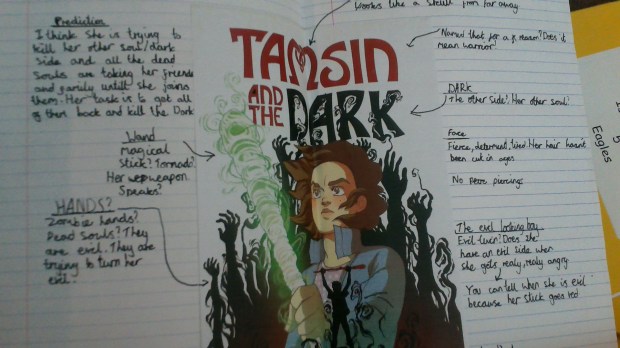
Following this task I had lots of children desperate to read the book who had previously missed it or ignored it on the shelf. The cover alone had captured their imaginations and one boy who can struggle to read consistently snatched it up at the first opportunity.
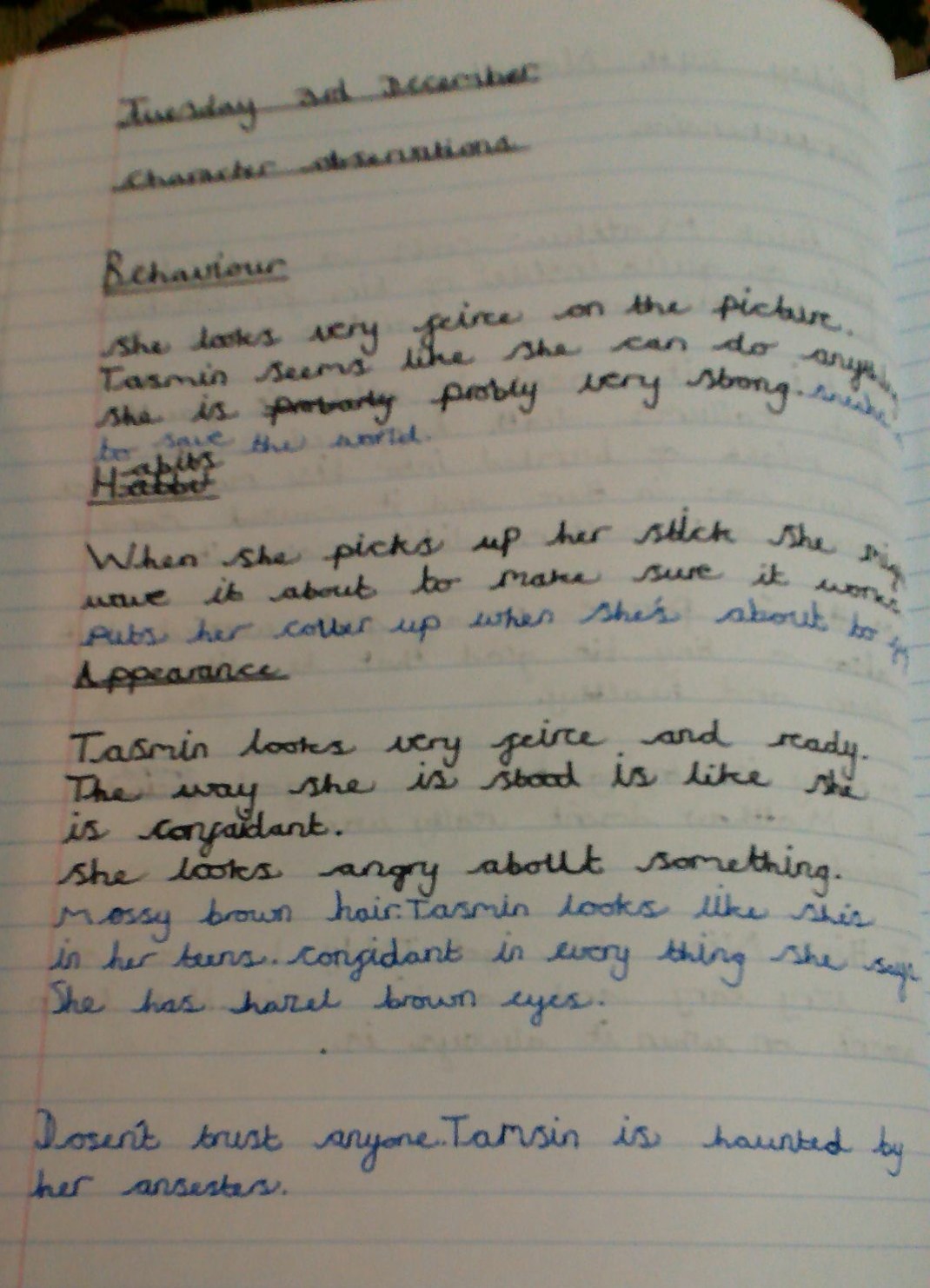
Our second day together remained focused on the front cover but this time we honed in specifically on the main character Tamsin. The class was split into three groups and each group was asked to describe, observe and predict a specific feature or area of the character. One group had to describe her appearance, one had to predict her behaviour and the final group had to try and figure out any specific habits she might have. They switched after five minutes and by the end each group had information for all three categories. Although her behaviour and habits may seem fairly close it was done in a bid to get them to focus on very small details for the habits section. I had to support the groups when they were on this section more but it actually led to some of the best observations. One girl picked up on the fact her collar was turned up on the cover and said “Every time she is about to go into battle she turns up her collar to show that she is ready.” Whereas those describing behaviour were focusing on more broad ideas such as ” I think she has to save the world” or “She has to fight evil.” After fifteen minutes every group had worked on each section and written down some ideas. Ideas were shared to the whole class and children were encouraged to write down any good ones they had missed.
After two days we had analysed the front cover in great depth and the children were really enthused about the book despite still not looking inside it. Our third and final activity moved away from the text specifically and we used it more as a source of inspiration in starting our own comic. The start of Tamsin and the Dark features two pages explaining the history of Cornwall and describing the past of the area. As a class we talked about how introducing a location or describing the setting can set up a story very effectively and provide the reader with important information that may become relevant later on. Backstory and intricate detail is something the year group on the whole struggle with due primarily to a limited reading diet. Recently I tried to teach them how to introduce a setting using the imagine sentence structure from Alan Peat. The sentence starts with ‘Imagine a place where’ and always has the same punctuation and structure, below is an example:
Imagine a place where the birds sing joyfully, where the rivers flow peacefully, where the sun shines all day: this is Mercuria
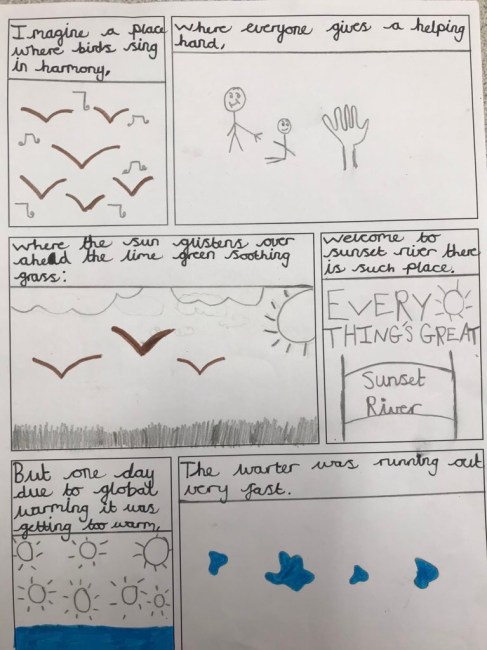
We used a visual prompt during that prior lesson and still a lot of them found it very difficult to imagine what to write or they struggled for different ideas and it became a list of the same things which destroys the world building intent of the sentence. I decided to revisit the sentence type but this time we were going to create our own comics and feature it in them. The children were allowed to come up with any setting of their own rather than limiting them to Cornwall where Tamsin is set. To help them I created an imagine sentence with them as a class and showed the process that goes into so they wouldn’t just use the first idea that came into their head every time. Then they were given blank comic strips and their only rule was that each time they got to a piece of punctuation in the imagine sentence they would move onto the next panel which would result in their sentence taking up the first four panels. I was apprehensive about this but actually the children understood the concept well and I found the less confident writers responded positively to it. It also ensured they paid careful attention to where the punctuation went which was another issue in the previous lesson on it.
Breaking down their thought process into one box at a time helped them to think clearly about what they were writing and knowing they would be combining art with their writing meant they were more enthusiastic about what they were writing. My least enthusiastic writer (and the one who will let you know how much he doesn’t like it) was inspired from the start because he found an empty box much less daunting than a blank page of A4. Being able to write a few words and then move onto the next box gave him a sense of achievement and really made him open up his imagination which led to him feeling an immense sense of pride in his work. Below is his imagine sentence from the previous work which he never finished and then his one from his comic:
‘Imagine a place where the smokey buildings lay, where soldiers were lead into a fight in world war 2 – this is where it ended because he was struggling to finish and became agitated by the work.
‘Imagine a place where bombs drop every blink of an eye, where bodies drop from powerful gunshots, where soldiers are expected to lose their lives: welcome to World War 3.’ – a clear improvement and completed in less time than the unfinished one above because he found it easier to follow the structure when it was split over four boxes.
By the end of the session most children had filled in at least one page but some had moved onto a second and were now into full story telling mode. This is where the imagine sentence works so well in a comic. Because they had all listed the best or worst things about their location they could easily work out where they wanted the story to go next with a lot of them finding it easy to identify what the problem would be in their story. Our work earlier in the week on describing the front cover came into effect as well because they started to focus on more specific details to help drive the story forward or add greater depth to the backstory.
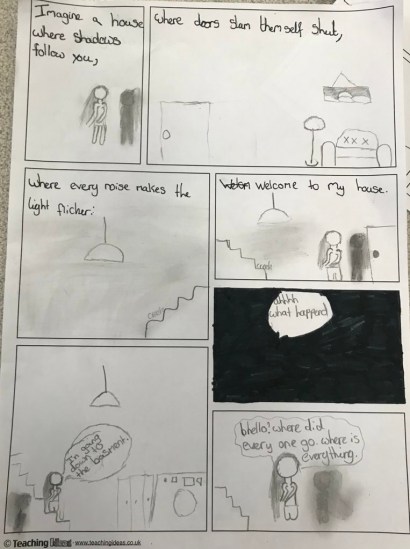
Seeing the whole class enthused was pleasing but the true success was seeing how many of them were working independently and only wanted me to see how hard they had worked rather than trying to rope me in to do their work for them. It allowed some of the less confident writers to see just how capable they are and by using a comic format the writing process was broken down into smaller steps which made them feel empowered. All of our work at the start of the week on story predictions, observing, analysing and discussing meant they really thought carefully about what was going to happen in theirs. Lots of them edited as they worked because they knew they couldn’t rush through the plot and it needed to follow their detailed introduction.
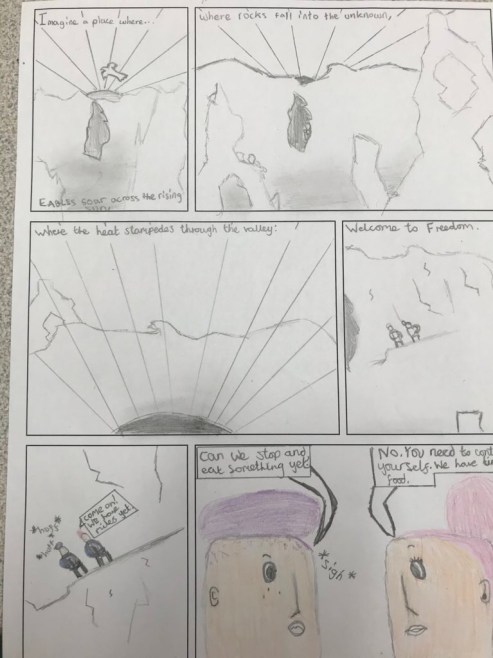
‘Imagine a place where eagles soar across the rising sun, where rocks fall into the unknown, where the heat stampedes through the valley: welcome to Freedom.’
 They don't count as reading