After a week full of wet play, timetable disruptions and just about everything else that could affect the quality of work in my classroom I finally managed to get some high quality suspense writing out of my class on Friday. Our first writing unit this year has been looking at how to create tension and suspense in writing with guidance being provided by the suspense toolkit from talk for writing. Thursday was supposed to be the day when the pupil’s combined all of the skills we had worked on to create brilliantly detailed writing that was full of suspense, diverse vocabulary and be completed to such a high standard that I would practically explode with pride. Instead it was a lesson where I questioned if I was good enough to do the job, if anyone had actually listened to me and whether I had forgotten how to teach. Friday morning came and as I finished looking at their work my plan of editing and improving the writing in our lesson seemed formulaic and irrelevant. I could already tell that most of them would just ask to rewrite it, several children would tell me they couldn’t possibly improve their work (even though it would likely be the weakest) and I would finish the week moaning for the entirety of my PPA.
In all honesty I still didn’t know what to do by the time the children had already entered my classroom and with my English lesson due to start at 9:15 because of a tennis session I turned to my trusty selection of graphic novels in a desperate search for inspiration. After finding out my TA still had the book at home that I thought would serve best I had to explore my lesser used texts. My saving grace came in the form of Locke and Key: Small World (sadly it contains the word whore so I don’t feel comfortable sharing it with the class) which is full of gothic imagery and horror themes that lend themselves well to writing a suspenseful piece. However I actually chose an alternative cover from the bonus content at the back of the book because it was simple and open ended but would create excellent discussion, which in theory would benefit their writing. I chose to give each pair an image of a key which had a house on it.
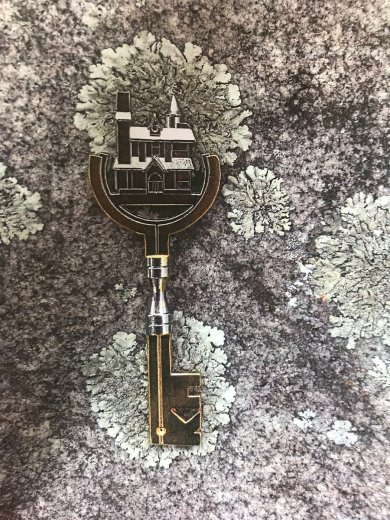
We started talking about what the key could be for, ideas such as new worlds, treasure chests, churches, secret passages and even cities hidden in the clouds where offered. Next the discussion turned to where the key could be discovered, suggestions ranged from the beach, hidden in a picture frame, the sea bed and simply the floor. This was where my input ended, the requirements were outlined quickly and then the class was set on their way to creating the best suspenseful writing they could. They were only asked to write two paragraphs, the first one would involve them finding the key and in the second they would use the key and start to experience something strange. By ending the work here it set them up for an easy cliffhanger.
Immediately I could tell the work was going to be a huge improvement on the previous days attempts. Every child was earnestly trying to use the full range of their vocabulary, sentence sizes were being varied appropriately and most importantly events were being drip fed rather than everything happening in about two lines (trust me this happened a lot on the Thursday.) The room felt more positive, energy levels were noticeably higher and even those who normally struggle were enthused. As a teacher I could feel a difference in myself and it was one of those lessons where you realise why we do this job in the first place, to see children trying to miss break time to work and begging for a whole day of writing was inspiring, it was also a stark contrast to the previous day when the same children celebrated the end of their lesson because they had enough of me asking for more.
Reading through the work during my PPA in the afternoon was enjoyable and looking at the two pieces of work side by side showed dramatic improvements. I know everything shouldn’t always come back to evidence but at the same time having such easily irrefutable evidence that the work had been improved was pleasing. Below are some the best examples I found, none were perfect and everyone had room to improve but these demonstrated that the skills we had practiced were being applied.
‘It was weird there was no one here. As I turned to leave, the door slammed shut, then it clicked. Suddenly there was a voice “You’re not leaving.”
‘When I opened the creaky door, I saw a big room with yellow walls and light brown floorboards, the whole room was empty except for one thing. A picture on the wall. Whilst holding the picture to examine it the back fell out and a little golden key tingled on the floor. Later that night, I was laying in bed trying to get to sleep. I heard something. A noise. It was coming from the locked room next door.’
‘It was a normal day, normal town, a normal life and normal neighbours. But today was different. The sun was sleeping and the moon was awake, a storm was striking what seemed to be only my house. Strange. Strange indeed.’
‘Opening the box, my life flashed before my eyes. It was over … ‘
‘ Every time I said those words the key glistened again and again. Then I saw it. In the walls I saw a little shudder. I touched the walls, it all happened again…’
‘I felt the sudden urge to go in, but a voice softly called my name, several voices actually. They warned me to go back, their voices synchronised. How could I turn back now? I paced towards the church disobediently, but something stopped me in my tracks. Something was in my freezing hand. Something cold, something smooth, something hard…’
Each of these is from a different child and there were other excellent examples that I haven’t included as well. I know they aren’t perfect but this post isn’t just about the quality of work produced. It’s also to remind us that sometimes as teachers we can over complicate things, we get in our own heads and make it harder for us and the pupils. In an age of evidence, data, standards, non negotiables and every other buzz word flying round staff rooms across the country, it is easy to forget that sometimes we need to make a task as simple as possible and let the pupils lead the way with it. I can admit that anyone observing me on Thursday would have wondered why I was allowed near a year six classroom, it wasn’t good enough. Yet one day later with less planning and preparation I felt the most enthused I had so far with my class, because I did less and let them do more. The lesson wasn’t revolutionary, many people have used a picture as a writing stimulus before me. But the success a simple, open ended image can yield is the key message I want to pass on. Sometimes the simplest ideas produce the best results.
 They don't count as reading