Over the past few weeks SATS fever has started to sweep year 6 meaning the chance to teach with comic books or try something considered a risk has become a very slim possibility. Although we are trying our very best to keep the curriculum broad and not just turn lessons into revision missions, there are times when you have to focus on the gaps no matter what. However thanks to the work of Wayne Tennent and the technique of text marking that he taught us on a reading course this year I have been able to sneak in some comic based lessons which have also served a SATS based purpose. In a bid to help develop the deeper thinking skills of our year 6 pupils both classes have been working on exploring what a text is truly showing us and what we can read from it. Credit must go to the mighty Jon Biddle who in PPA last week read the fantastic Mr Wolf’s class (buy it for year 4,5 &6 if you don’t have it, great book and they love it) and then said how he planned to use it for some text marking work. Being the resourceful practitioner that I am I stole his idea and did it as well because he said it so therefore it must be a good idea!
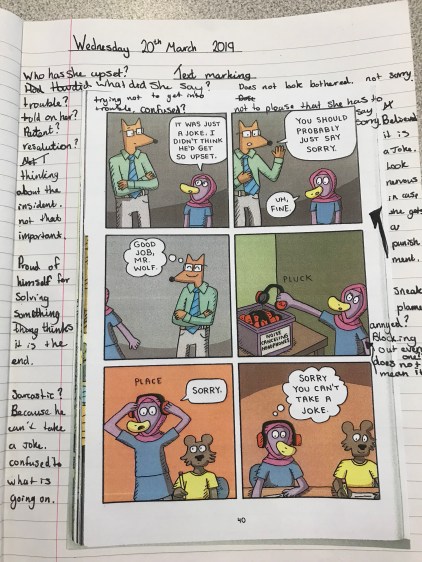
The page in question involved a teacher asking a pupil to say sorry for something that wasn’t really a problem just so they could settle the issue. In predictable fashion the child apologises but doesn’t mean it and didn’t actually care about being sorry whilst the teacher thought he had settled the incident perfectly. We’ve all been there ourselves and will continue to deal with it on a daily basis as long as children exist. We decided to go through and mark all over the text about what they thought the characters were really thinking, why the teacher was settling it this way and what their body language told us about their real intentions. The class picked up on lots of subtle details and nuances that at first glance they had ignored. After marking it we talked about their findings as a class which allowed others to pick up on things they had missed. The discussion ranged from the character saying sorry being sarcastic rather than really meaning it, the teacher being smug even though he hasn’t really settled the issue, turning your back on someone to show them that you don’t actually mean your words and even how rushing off after the teacher has said shows a lack of respect.
The discussion was really productive and plenty of the class had picked up on little facial expressions and clues in the text that others had missed including myself. We followed this task up by looking at three questions based around the text. The questions were based on looking at the text, using a clue from the text and then using their own thoughts about a concept related to the text. The final question was What do you think makes a good teacher? This question required us to discuss all the different areas of life that people teach them in rather than just focusing on teachers at school. Many of the children hadn’t considered just how many different people teach them and how they teach others themselves. This question prompted some interesting discussion which revealed many of them considered a good teacher to be someone who could demonstrate the skills and knowledge required themselves, possessed patience and was kind and caring. Most of the children were adamant that the person teaching needed to know or show how things worked rather than just being people who could tell them what to do. When talking about who the best teachers in their lives were a lot of them recognised their parents or grand parents as people that have taught them a lot along with brothers and sisters. Interestingly some also suggested their parents were the worst teachers because they didn’t have the knowledge or patience to do it properly!
Following on from this task (later in the week) we then looked at another page from the second Mr Wolf’s class book which I felt would address some of the issues we were having as a class. This time we decided just to mark and discuss the text rather than moving onto three questions afterwards. This time we looked at a page where several seemingly innocent lies got out of hand and led to a character believing an old teacher had potentially been abducted by aliens. Working in pairs the class had about 30 minutes to break down the text and explore what was happening and more importantly why it was happening.
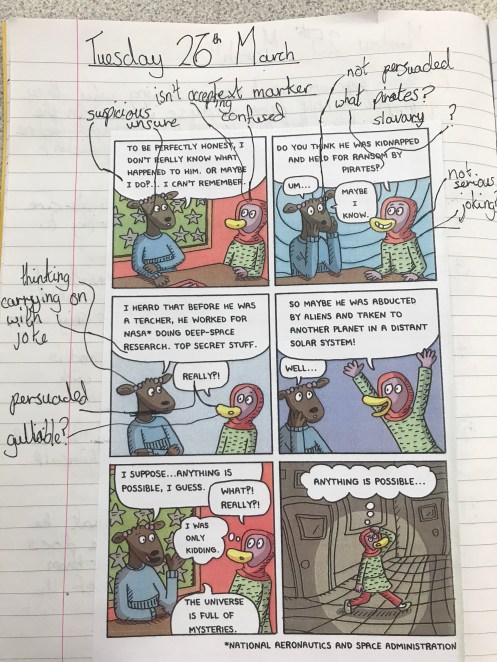
I was surprised by how many didn’t understand what the word ransom meant but this presented a great opportunity to demonstrate how they could use the words around it to establish a potential meaning. About half way through the task after rushing through all the words most of the class started to say they were finished which I knew they were definitely not. Rather than stop there and discuss I simply informed any child who told me that to look further into it and start thinking about more than just the words. After a brief whinge about being made to work harder every group went back to the task and started to pick apart tiny details of the text which led to lots of fantastic paired discussion. Slowly they realised that the page features constantly changing backgrounds which could be related to the way the conversation is going between the two characters. Lots of them picked up on the spotlight on the last panel and the wonky features in the corridor which didn’t fit with the rest of the page. Facial expressions were studied and allowed them to draw conclusions about the intentions of the words as well as answering questions they had about the start of the page. When it came to stopping them many begged for more time as they were engrossed in extracting everything they could.
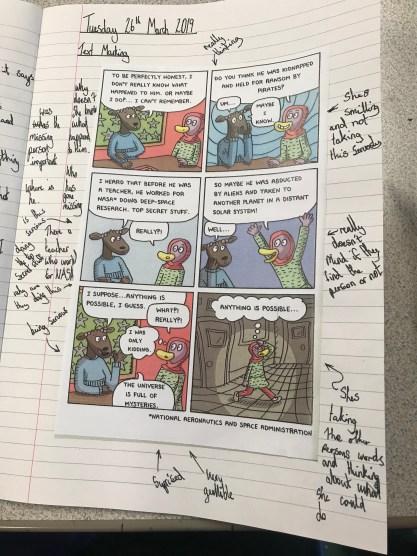
To finish we discussed our findings as a class and I teased them towards the idea of fake news and how it is important to be more aware of this than ever. In the previous week I had settled multiple arguments based on children either lying to each other or misreporting events. Their words gathered momentum and got out of hand before thankfully being resolved by the end of the week. This page gave me a great example of this happening and allowed me to draw comparisons to our struggles in class. As a final point of discussion I talked to them about the fake articles that are constantly put up online and the importance of evaluating what you are reading to try and ascertain if it is genuine or not. Quickly I had hands shooting up to tell me about when they had fallen for fake news themselves or examples their parents had shown them being spread on social media. Using the text to get to this point seemed to connect well with them and for those who may struggle to quite understand what I was talking about it gave a concrete example of how a simple joke can quickly get out of hand whether you mean it to or not.
 They don't count as reading