Today was one of the most enjoyable English lessons I have taught in a long while but it was nothing to do with hours of preparation or some form of genius idea from myself, all credit must go to Dr Wayne Tennent and the recent training of his I have been fortunate enough to participate in. Over the past few months my school has hosted several reading training sessions with the primary focus looking at different ways you can teach comprehension. I personally have found the training incredibly inspirational and the impact it has had on my teaching has been easy to see. The work has looked at how we can get more from comprehension sessions without children having to fill out pages of questions or providing books full of unnecessary evidence just to prove that you can teach. In the last training session we looked at the idea of text mapping and it struck me as a brilliant idea that would help improve my teaching immensely but also immediately.
The process involves looking at a piece of text or image and noting down the different thoughts that come into your head as you go. These notes can be questions that are answered later or remain unanswered, simple observations, predictions, background knowledge or even just a reminder to yourself. We decided in year six that we wanted to try this as soon as possible and get into the habit of utilizing it. Originally the idea was to work with the text Gorilla by Anthony Browne but while I was reading last night I came across a page in World War Hulk that seemed perfect for the task. I debated whether to take the risk and try text mapping with something I hadn’t fully prepared for but I couldn’t shake the idea that it was ideal for what I wanted to achieve and I would regret it if I didn’t take a risk by trying it.
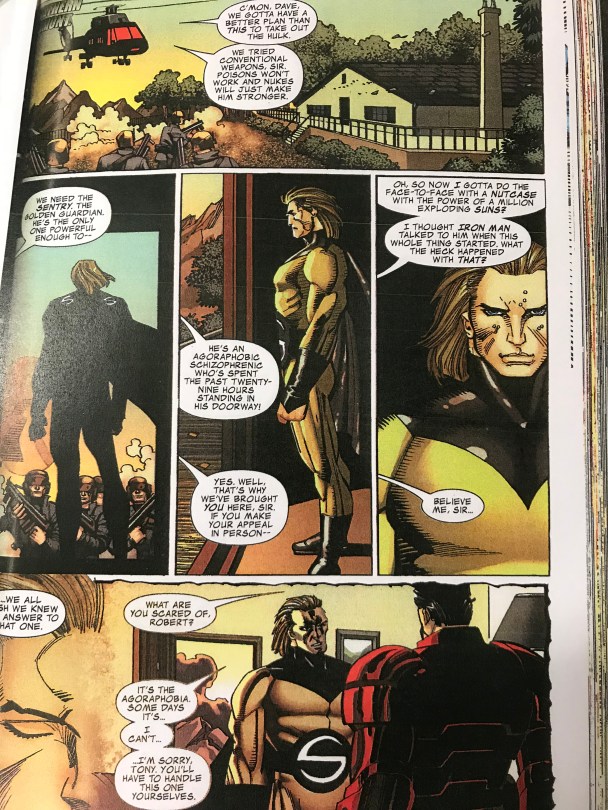
The page is set towards the end of the book when Earth realises that it must convince the schizophrenic and agoraphobic Sentry to come to the rescue before the Hulk destroys everything. I was struck by the idea of a savior who couldn’t leave the house and the rich discussion we could have about this issue. As this was the classes first attempt at such a task I worked through half of the page with them and modeled how to approach the task by voicing my thoughts out loud and explaining what to note down by the side of the text. Initially I was preparing for a long exploration into the word agoraphobic and how we could use the text information to help us work out what it meant only for several children to already know and dash my big plan! However this gave us a good chance to explore the text in order to make sure we were correct and by looking at the image of him trapped in the doorway we ascertained that our initial thoughts were correct.
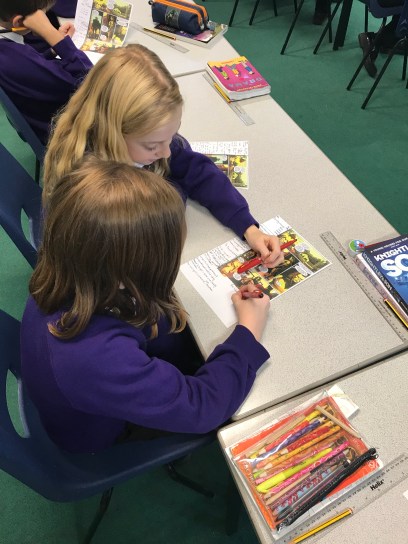
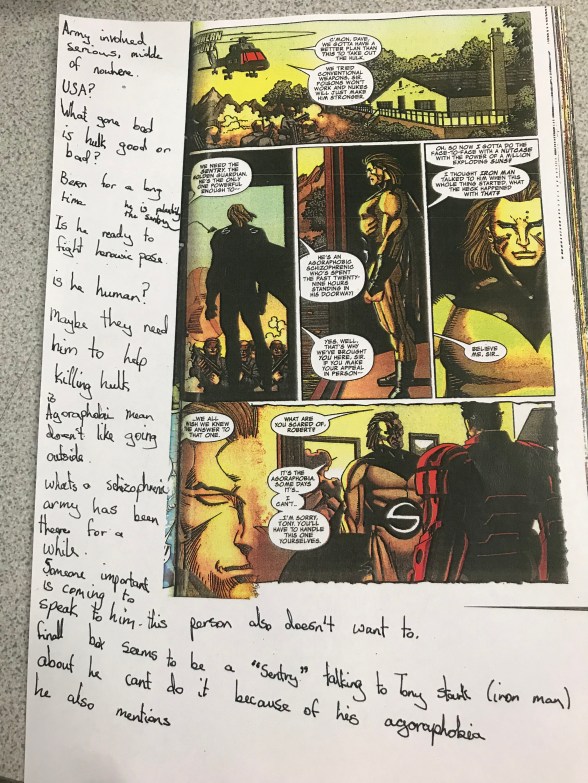
After this I let the children work in pairs and gave them time to carry on annotating the text whilst I did the same myself. After everyone was satisfied that they had written down everything they wanted to we discussed our thoughts as a class. Normally you would do this with a group but due to my class being fairly small I was able to get away with a whole class approach for today. Whilst discussing our thoughts together we wrote down any new ideas we had in a different colour (purple) to show that these were from further discussions. Our discussion led us to answer some of our earlier questions so we made sure that these answers were written down to demonstrate how our earlier thoughts were related to later findings. This whole group discussion raised some fascinating insights from the children who had perceived some of the text differently to me. Ordinarily people would see this as a bad thing but I was delighted as it gave us a chance to have the best conversation I have ever engaged with this year, full of rich vocabulary that I wasn’t aware some of them possessed. Topics ranged from the idea that Sentry could be a robot, was the Hulk a hero and whether it was possible for robots to suffer from mental afflictions such as agoraphobia.
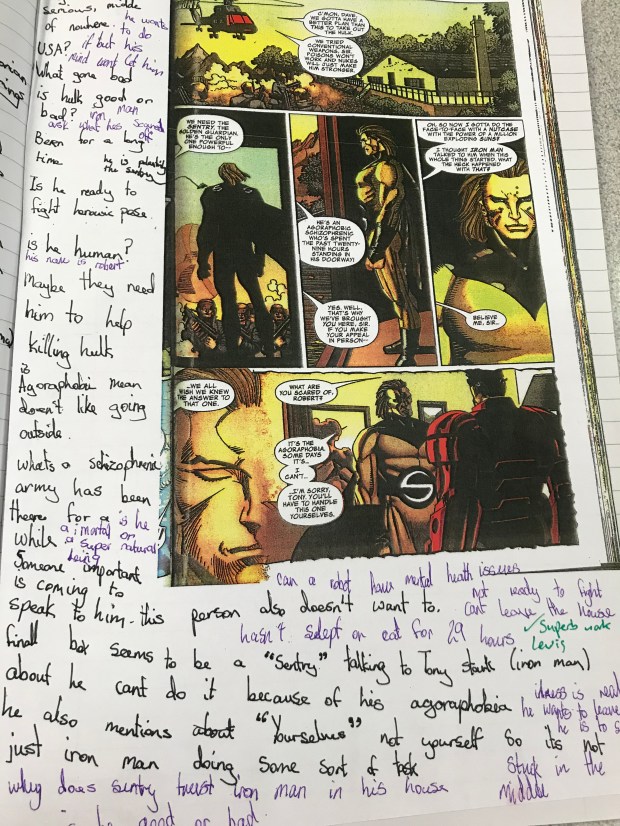
To finish the lesson I posed one final question to the class which I knew would divide opinion and lead to the discussion I was most interested in. I asked them if they felt Sentry was selfish for not helping out and refusing to leave his house. Initially many of the class were quick to judge and several said he had to be “Because he only cares about himself,” and that “he might be self conscious,” and more concerned with “protecting himself.” Eventually the discussion came round to whether he truly had a choice in the matter and one child summed up the problem perfectly by explaining that “He clearly wants to go and help but his mind won’t let him do it.” All of a sudden children started to change their minds and explore the idea that he may not be in control of this choice whereas initially the suggestion was that Sentry was only looking out for himself. Although some still felt he should be able to conquer his fear in order to save Earth they had started to look at the other side of the argument and were able to appreciate that he may not be the self obsessed character they suspected he was. Finishing with this question allowed the children to use the information they had collected during the text mapping and apply it to their point of view which has been a weakness previously in the year. Hearing more detailed explanations from children who can struggle to express themselves was truly inspiring and left me feeling motivated for the rest of the day. Below is a finished text map from one of the students who extracted everything he possibly could from the task, although the layout is a little chaotic I would much rather have that instead of a beautiful looking sheet that has barely any ideas on it.
 They don't count as reading